Faster loops, bigger playgrounds, stronger craft
Reflecting on my second year at Linear — designing for AI, deeper async collaboration, and the lessons that shaped this chapter.
Dec 4, 2025
7 major feature contributions this year, 4 built around AI: Pulse, Triage Intelligence, Auto-apply triage suggestions, and issue description summaries. Two more AI projects are in the oven. Agents have definitely become the team’s new playground.
The ships themselves matter, but what stood out more this year was the cadence behind them: how the work happened, how decisions got faster, how we aligned quickly, and how my week stayed simple while the work matured.
Day-to-day and culture
Structurally unchanged, 90% of my time is dedicated to IC work (Google Calendar's insights say 88.8%). My weekly meetings are:
45 min EU Sync on Mondays
45 min Design Sync on Tuesdays
30 min Quality Wednesday on… Wednesday
30 min 1:1 on Wednesday
30 min Project syncs × 2 or 3 depending on how many I’m working on
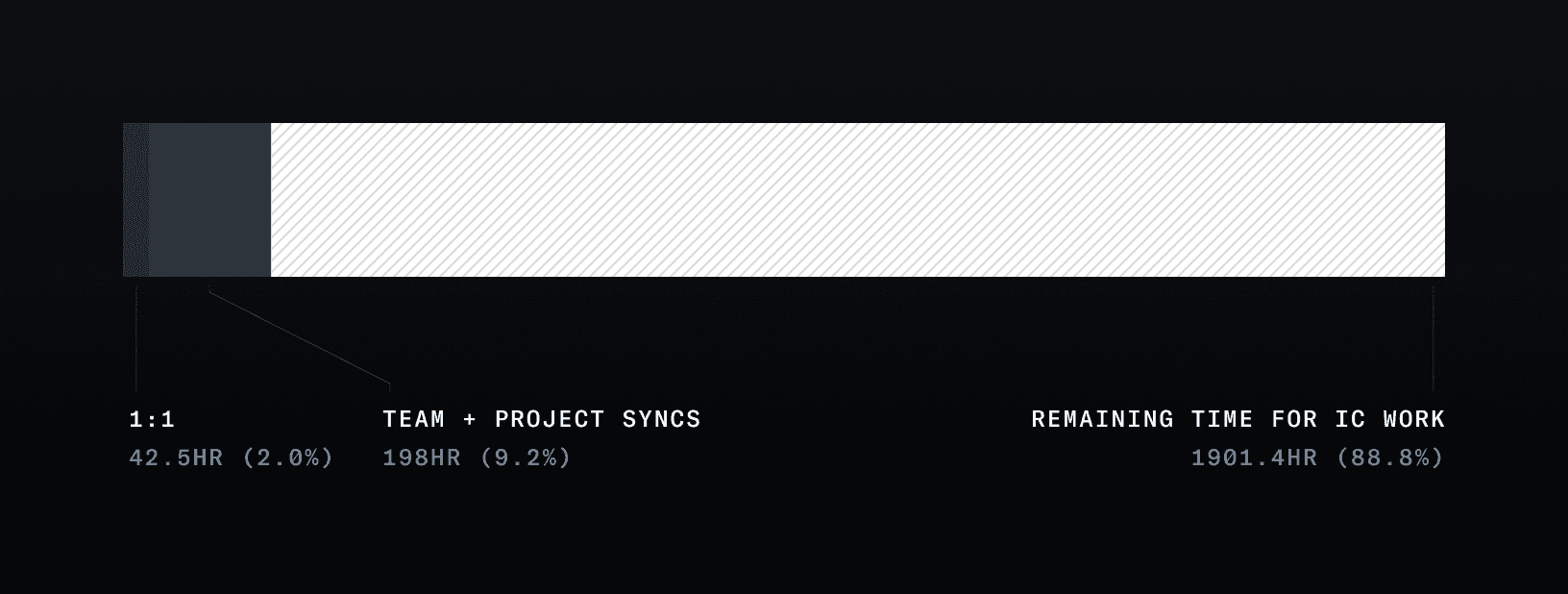
Add to this our monthly All-Hands and that’s it in terms of time spent on Zoom. I wrote this a year ago and it’s still absolutely true:
Without the constant need to over-communicate or ‘prove’ productivity, I could pour all my energy into the craft itself. Over time, this environment has allowed me to work with a sense of calm and purpose, even when tackling high-stakes projects.
This may be a generality for some, but it doesn’t seem to be truly understood yet by companies and people who want to move faster: protect your time, make it sacred, and rely on async. Writing and 1.5× video are better for focus.
What changed this year is that the center of gravity shifted — I went from collaborating mostly with EU teammates to working almost entirely with people on the West Coast and NYC. And because my default has always been async communication, the shift just amplified it. My work became even more a chain of written and video thoughts: quick updates on Slack, Linear comments, and Figma prototypes recorded with CleanShot. The already low number of “let’s jump on a call” moments stayed low, but the amount of async context increased a lot.
As a result, communicating more async made me much more intentional about how I present ideas. You can’t pitch the same way to everyone:
a screenshot or quick video with a short caption might be enough for some
others may need to play with the prototype directly
and sometimes the best move is to drop a seed in a meeting and let the group naturally arrive at your idea, the designer’s magic trick.
Different minds, different mediums. Same goal: get to the required level of fidelity as quickly as possible to check your concept.
Leveling up with AI
I think it’s safe to say that my biggest highlight this year was the release of Triage Intelligence, for three reasons. Even though this wasn't our first AI feature, this one felt special given its nature.
First, generating summaries that don’t feel like slop at all isn’t a fully solved equation in 2025. As a result, something more complex like suggesting an appropriate team, project, assignee, or label felt like a challenge. Trust is probably the keyword here because, even if Linear managed to build some over the years, how can you possibly tell if the suggestion is worth opening or not at first glance? Reasoning tooltips were our answers to this, with providing alternatives as well. We went over design and implementation details in a dedicated article with Matthijs Wolting (Engineer) if you want to learn more.
Second, using reasoning models — AI as a new primitive, has led to faster decision-making, not slower. Linear has always aimed to have a working prototype within the first days or week, but here this goal has been even more amplified. We explore a broader spectrum of concepts, so we better know where to aim for the next iteration. Features like Pulse¹ and Triage Intelligence have experienced a ridiculously high amount of variations.
And lastly, the scale. Triage Intelligence is one of the first self-driving product operations capabilities of Linear. Contributing to this suite of features kept me excited throughout the year, and it still does! Having a masterpiece of a video produced by Meg Wayne (Motion Designer) significantly contributed to the success of the feature’s launch.
Evolving the AI design language
A big part of my work this year was contributing to shaping the foundations of our design language when it comes to AI — the activity states, the agent statuses, how progress is shown, and how the system reacts. These patterns will evolve a lot, but this year felt like setting the first stones.
Made a quick retrospective video highlighting some aspects of the design language we adopted for AI features
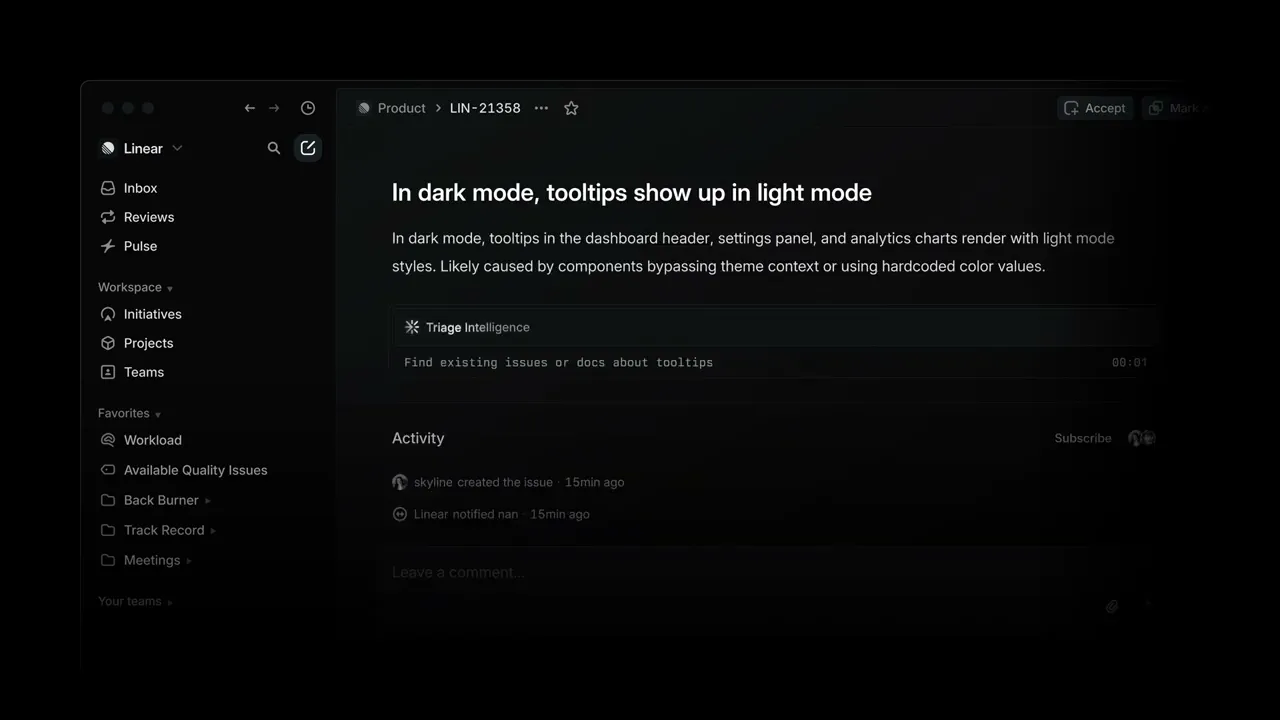
Another aspect that I particularly like about working in this space is that every company is trying, pushing, and challenging the patterns, proposing new ones. From a pure designer's point of view, this is super exciting. The goal now is to push all these patterns further — simpler, clearer, more universal, in a way that feels even more native.
I’m particularly excited about orchestration: how agents interact with users, how they delegate work, how users maintain control when many things happen in parallel, and how to surface all that activity without overwhelming people. Now that are foundations of these AI features are in place, we're building solid bridges between them.
Personal reflections
Two years in, the feeling is the same: there’s still so much to build. Balancing simplicity with the growing nature of software development tools is another interesting challenge, especially for a tool like Linear that began with IC engineers.
But the mindset stays unchanged: clear goals, high standards, and doing your best work in an environment that lets you operate at your peak, with teammates who are both highly skilled and supportive.
This year also reinforced something I’ve been feeling for a while: the boundary between design and engineering keeps fading. Experimenting directly in code is faster and more honest, and AI only amplifies that speed. The Rosetta Stone overlap is larger than ever — you prototype in reality sooner, iterate earlier, and get to the truth of an idea much faster. It makes the work more fluid, and honestly, more fun.
A few things I keep coming back to:
Be proud when you ship, not relieved — relief means you’re happy to be done. Pride means you care about how it lands and whether it actually helps people.
Dogfood everything, not just for the sake of it, but to develop instinct, taste, and opinion. It’s a privilege to be our own users, allowing us to take shortcuts, but this is where empathy plays a crucial role. Real empathy — the human kind, cannot be replaced by any LLM; it’s about emotions.
Side projects matter more than you think, they sharpen your mind, give you new perspectives, and create friction that mirrors real product work. Even more when your tool is used by makers.
Imposter syndrome is a tool. Leverage it before it leverages you. If you never feel it during the week, you’re not really growing as fast as you can².
Looking ahead
This second year at Linear didn’t change my work dramatically — it just sharpened it. Same craft, same rhythm, but more intention behind everything: more async, more ownership, more code, more prototyping. The surface area grew, but the core stayed the same: protect your time, focus deeply, and care about every detail that leaves your hands.
Linear remains one of those rare places where you can actually do your best work. High standards, low ego, fast loops. A team that trusts you enough to move quickly, and a culture where the shortest path from “idea” to “let’s try it” is always encouraged.
Working on AI-related features this year didn’t replace the craft — it expanded it. The real challenge wasn’t automation, it was clarity. How do we design things that feel confident, explainable, and helpful without adding noise? That’s the part that energizes me: refining patterns, making concepts intuitive, and shaping how people understand what the product is doing on their behalf.
There’s still a lot to figure out — not in a dramatic way, just in a genuinely exciting “there’s more ground to explore” way. If year one was about finding my footing, year two was about stretching into a bigger playground.
Year three? Keep the standards high, keep the curiosity alive, contribute to that culture, and keep doing the work.
S/O to Rémi Bonnet and Conor Muirhead for the thoughtful notes that helped refine this.
—
Q&A
About two months ago I asked on Twitter what people wanted to learn about this second year at Linear, here are the ones I didn’t cover in the writing above.
From Laís Lobato: how do you decide what to build next?
We maintain a backlog of projects and a set of strategic initiatives (our long-term axes) that group them. Planning is continuous and based on a mix of impact of previously shipped features, customer requests, and our own product vision.
What also makes the difference may reside in a few aspects:
A virtuous circle with customers — our CX and support teams keep signal incredibly clean. They make it easy to understand what people are trying to do, who we’re helping, and where a feature actually lands. It’s one of the engines of the product.
Fast reality checks — once we commit, we validate value as quickly as possible (within ~5/10 days, sometimes less), first internally. If it helps us, it usually helps other companies too.
Storytelling — the Magic/Packaging team puts real thought into how each feature fits the broader narrative of Linear. When the story is clear, finding the next chapter becomes much easier.
Our practice articles on linear.app/now go deeper into all this.
From Meg Wayne: what did you learn about how best to collaborate with engineers and get ideas you feel strongly about implemented?
We talked about this at our EU offsite in Marrakesh recently. For me, it always comes back to how well you can articulate the idea — and how much you can get the engineer excited about it. Designers and engineers are both makers; we just operate in different mediums.
Software is made of lines of code, not bitmaps. The more fluent you are in that language (and the more engineers practice yours), the more transparent the wall becomes between the two tracks. That’s exactly the point of the Rosetta Stone.
From Ali Salah: how do you keep your quality bar that high while still shipping a lot?
We genuinely care about what we ship, how it feels, and how it helps people. And that forms its own virtuous circle: Great makers → Software that feels magical → Polished, high-value features → Software companies and makers notice → More great makers join / More customers → Repeat
Practices like Quality Wednesdays and our Zero-bugs policy also keep the quality bar high.
From Raj Solanki: what's unique about the dynamic at Linear that lets design and engineering influence each other so well? And how has that shaped the way you approach your own design now?
High hiring and quality bars mean people share taste, instinct, and a sense of what good software feels like from day one. So alignment is easier, feedback is more direct, and trust is high. And people call things out openly when something isn’t at the level it should be. That environment raises your own standards over time.
From Samket Pathak: what are the trade-off(s) that may sound insane to the B2B world but totally normal in Linear?
The one that comes up the most in conversations: we rely partially on screenshots a lot when designing in Figma. Some people find this heretical, but designing in context keeps us fast and grounded. It seems a lot of designers got brain washed by the design system gurus, but that’s a topic for another time.
Another trade-off is that we keep project teams intentionally small (1 designer, 1 or 2 engineers max.) while the product surface grows faster than headcount. Most companies scale teams to match the roadmap; we expand leverage instead. We do hire, but never at the pace of the product — and that’s by design.
Footnotes and references
Latest notes
Analog by Ugmonk: my year of tangible productivity
A look at how one physical tool improved my planning, focus, and setup.
Jul 9, 2025
Introducing Inside Thunderstorm
A new video series documenting the behind-the-scenes of building the next major version of my website — the twelfth in ten years.
Jun 3, 2025
Keeping track of achievements
Deep dive into how track records accelerate career growth, by helping you combat imposter syndrome and build lasting momentum.
Jan 28, 2025